-
About
- Kyoto Prize
-
Research Grants
-
Social Contributions
- Events
- News
About
Research Grants
Social Contributions

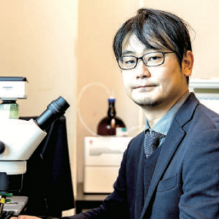
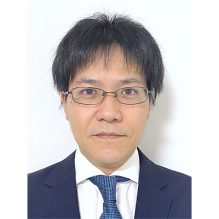
Lecturer, Faculty of Science, Hokkaido University *Profile is at the time of the award.
2025Inamori Research GrantsScience & Engineering
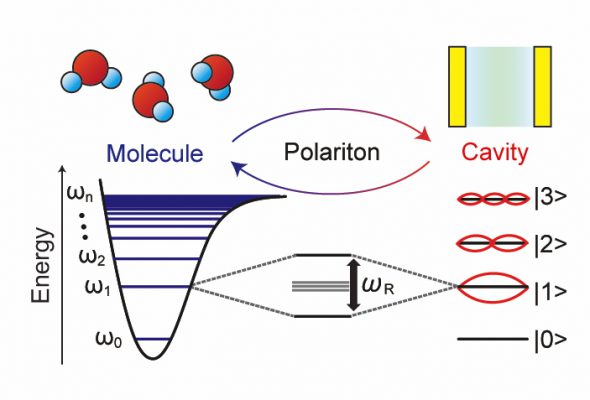
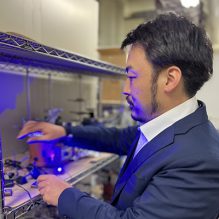
The interaction between cavity resonators and materials has been studied extensively in the field of physics, such as cavity QED. I am now working on the possibility of connecting polariton chemistry and photoelectrochemistry. I hope that this will lead to the control of electrochemical reactions in the future.
Vibrational strong coupling conditions were fullfilled with the coupling of molecules and cavity. In the OH stretching mode of water molecules, coupling with a cavity mode leads to the formation of polaritonic states. However, in electrolyte solution systems where solvation structures become pronounced, concentration-dependent polaritonic states reflecting the different chemical species present in the solution were observed. These findings suggest that molecular vibrational modes, which originally behave independently, can collectively couple to the cavity field and evolve into macroscopic polaritonic states.
Science & Engineering