-
About
- Kyoto Prize
-
Research Grants
-
Social Contributions
- Events
- News
About
Research Grants
Social Contributions

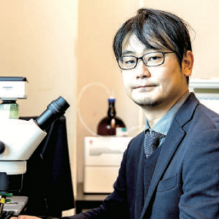
Associate Professor, Graduate School of Engineering, Osaka Metropolitan University *Profile is at the time of the award.
2025Inamori Research GrantsScience & Engineering
Polymer science has undoubtedly supported people's daily lives, but nowadays, the non-degradable plastics that have been discharged into the ocean are becoming an environmental problem. With the research grant from Inamori Foundation, I will strive to develop functional polymer particulate materials that can be degraded in the ocean, and do my best to contribute to solving environmental problems.
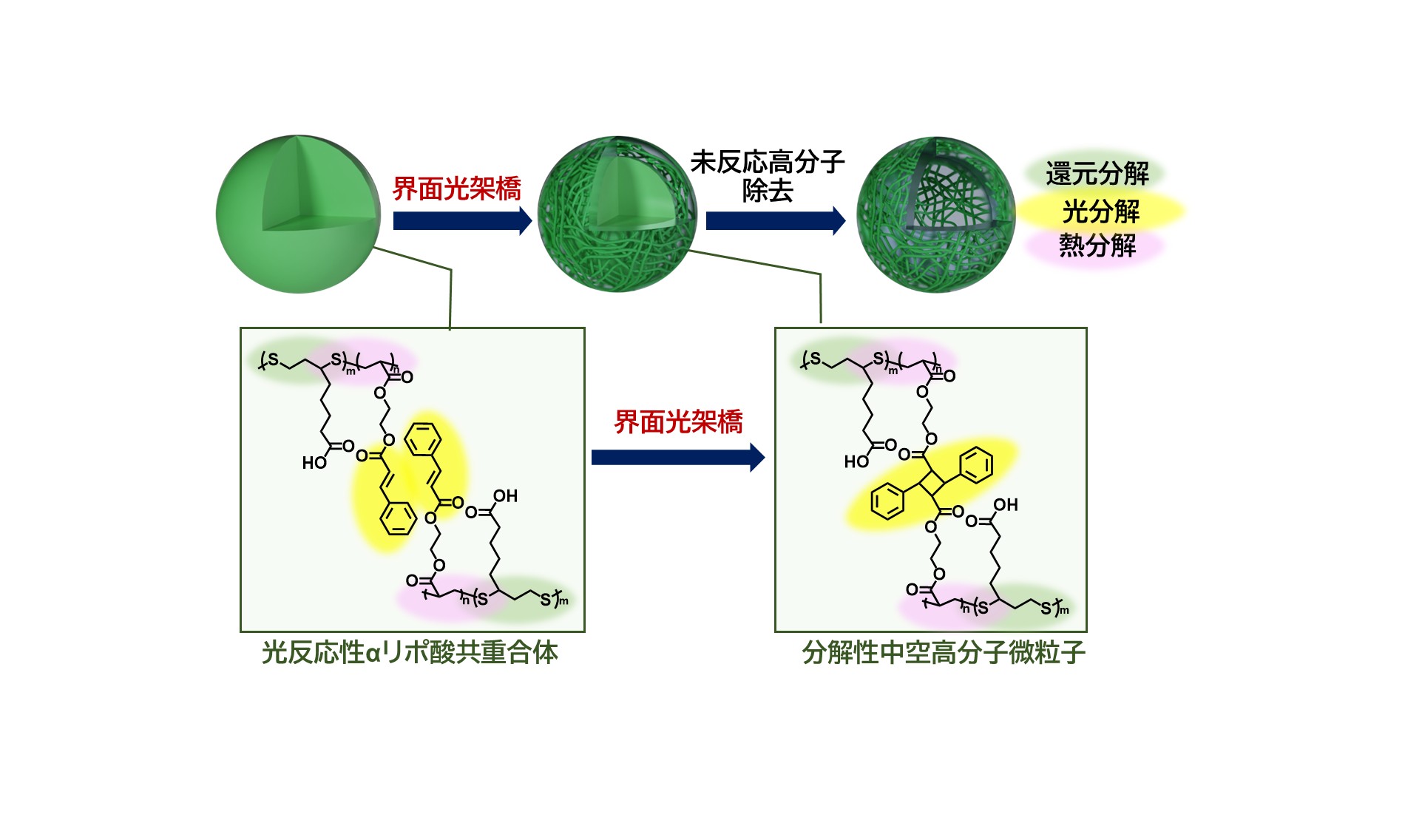
Hollow particles feature internal voids and possess characteristics such as high light-scattering properties and substance encapsulation capabilities, making them useful in products like cosmetics and fragrances. However, when polymer microparticles are released into the marine environment and lack degradability, they can become a source of the marine microplastic problem. In this study, we developed degradable polymer capsules by incorporating reduction-responsive degradable disulfide bonds into the polymer backbone. This was achieved by applying an interfacial photocrosslinking reaction to polymer microparticles copolymerized with α-lipoic acid, which possess both degradability and photoreactivity.
Yukiya Kitayama, et al. (2026) Redox-Responsive Ferrocene-Containing Polymer Capsules Fabricated via Interfacial Photo-cross-linking ACS Applied Polymer Materials 8(9) 6504-6510 2026 https://doi.org/10.1021/acsapm.6c00412
Science & Engineering